
PROVINCIAL BOUTIQUE, GLOBAL ALGORITHM: THE ART OF CURATION
When Form Leads You by the Nose

In fashion, everyone wants to be on the right side of history. The hype side, the trend side, the prescriber side. But nobody asks who writes this history. Spoiler alert: it's not the Parisian front rows or Instagram accounts with 500K followers writing it. It's people you don't necessarily know, living in places you've never heard of, who understand something essential that others have forgotten. They know how to translate.
The Art of Cultural Translation
If you want to speak to people and actually be understood, there are two options:
Understand the culture — its entry points, its exit wounds, its whole socio-symbolic scaffolding.
Or simply be the person you’re trying to reach. Talk like them, live like them, consume like them.
This ability to translate is now essential in a world where micro-trends are born and die in the space of a few TikToks. The brands winning today are those that master both languages: fluent in hype codes, but grounded enough to still speak to the everyday consumer.
The WAD Era : When Print Dictated the Tempo
When I started out in the early 2000s, the ecosystem was radically different. No TikTok, no IG. Just paper, ideas, and editors brave enough to push boundaries.
I was a journalist. I worked for the paper temple of sportswear, workwear, and denim. The magazine was called WAD. It was founded by Bruno Collin and Brice Compagnon. For years, people considered WAD one of the sharpest, most forward-thinking voices in the game.
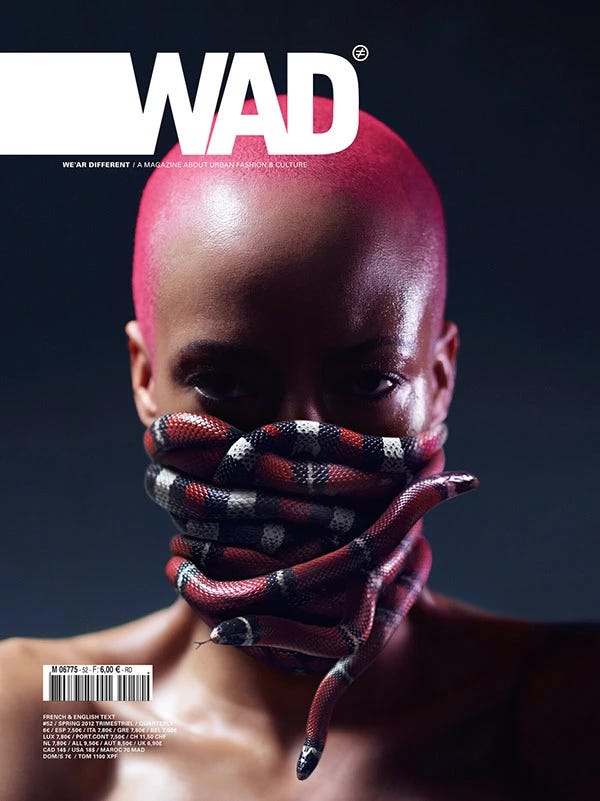
WAD was born and accompanied all the denim brands: G-STAR, DIESEL, ENERGY, MISS SIXTY, PEPE JEANS, MARITHE FRANÇOIS GIRBAUD... It was THE magazine, the king of bread and butter, it made and broke businesses, and served as a metronome for a denim and sportswear industry that was building itself. Its apparent strength was its ability to work with all the creative youth from around the world, but especially European, with the biggest personalities who were still rookies and have all become references today. It was a fantastic cultural and artistic breeding ground.
WAD was an institution, a standard. Especially at a time when social media and the internet didn't exist yet. Paper set the tone. The strength of its editorials, often criticized for their very falsely artistic interpretations, or not polished enough, too off-kilter compared to Vogue Uomo or Numéro, it bridged the gap between Japanese media like Popeye, Street, and European fashion reference magazines. Never too intellectual but sufficiently different and differential. Especially with traditional print media that didn't yet venture into these textile categories and didn't know how to talk about them.
A different casting, a different tone, different photographers: WAD (We Are Different). You could criticize the form but it was a breath of fresh air and a UFO in the fashion world and especially in the Bermuda triangle: denimwear, sportswear and neo ready-to-wear that was being spurned by fashion institutions and haute couture authorities, who closed doors and access to them. Bruno Collin and Brice Compagnon didn’t just open a market — they gave a voice to an audience no one knew how to speak to, and most didn’t even want to. And to speak to people and make yourself understood, you have to be able to speak the same language.
Their business model was relentless, and the mechanics perfect: of course an insane library of advertisers, and an incredible relationship with all the brands but especially a proximity with all the small provincial retailers, from France and beyond. Receiving WAD at your boutique was the equivalent of Instagram's blue checkmark. The Michelin star of cool, it was the Parisian label that came to land in Dijon, Le Mans or Barcelona. The magazine carefully distributed these little paper sesames as a priority, with as much care as it would have treated an advertiser. Because without this retail curation of the small provincial boutique, these brands wouldn't have been able to make such big numbers. Orders poured in thanks to their perception of what their store should be by devouring the magazine's pages.
The Genius of Provincial Translation
So what was WAD secret?
Bruno’s strength wasn’t style. It wasn’t strategy. It was language — and his ability to speak two at once. He embodied the provincial consumer while addressing the fashion industry with the codes it craved. He didn’t translate between those two worlds — he was both.
He wasn’t from the Parisian fashion elite. He didn’t pretend to be. That’s exactly why people listened. Bruno spoke to brands and buyers in a tone they could trust — not with trend forecasts or high-concept jargon, but with gut instinct and street-level understanding. He offered them something rare: a cool that was both aspirational and accessible.
He knew exactly what the small-town jean shop owner needed — because he could had been one. And he knew what the fashion world wanted to believe in — because he had learned how to speak its language without ever belonging to it. Paris was a backdrop. His work was for Dijon, Nancy, Montpellier. The series and themes he published were always dressed in hype but rooted in retail reality — before streetwear was luxury, before sportswear became runway. Before denim wear was even able to write a visual language.
What he did with was only possible because he wasn’t alone. His vision was carried — sometimes even transcended — by the talent around him. The creative edge of the moment. And the eye of Brice Compagnon, whose casting lens turned subcultures into style codes, long before Instagram could flatten them.
From Provincial Translation to Global Niche Translation
The allegory of this provincial jean boutique: it was an economic model at time T that can today be called Outlander or Shein. There will always be people to embody the consumer and translate that consumer to brands. Those who succeed best are those capable of a double language - both with this boutique and this brand - and express it through their media. Brands don't need geniuses, they need translators.
Today, the cool little store has splintered into millions of IG, TikTok, and Pinterest profiles. They’re not just curators — they are the consumer, turned into media. They show their audience exactly what they want to see — fantasies included — because they live it. Globalization is just a bigger playground. The provinces are now infinite niches.
Is Simon Jacquemus one of their heirs, at a higher-end level? Very likely. Same equation: split language, half Proustian Provence, half Parisian front row.
Curation Over Substance
We're witnessing the birth of media that reproduce WAD's visual impact but often without its depth. Outlander, The Fashion Law, Cart Department, Hidden NY, Advanced Research, UpNextDesigner, NoMore Rulers: impeccable contemporary form, millimetric curation, but sometimes superficial diagnosis. We validate doors already kicked in, we avoid subjects that anger. These are the new provincial boutiques, but on a global scale. 4 products or beautiful photos, put in carousels with bold typography, are enough to be highlighted with superlatives found on AI.
These new media excel in form - careful artistic direction, prestigious collaborations, Instagram-ready aesthetics - but struggle to develop a true editorial vision.
The Post-Algorithm Generation
Just like their paper predecessors, and other translators of new denim cultures, these new supporters of the small provincial jean boutique favor algorithmic engagement over taking positions. They master the art of "scroll-stopping" but often fail to explain (for now) the reasons for their choices. The result is crystal clear and we fall into it like sugar.
They comment on the existing rather than create it, they accompany rather than precede. Without really knowing why the new CELINE collection should be highlighted rather than the previous one. The result and enthusiasm are the only guarantees of a critical vision. And it works very well.
The System's Fragility: The Illusion of Commentary
The real fragility of this type of media doesn't rest on their ability to adapt to changing cycles - they can adapt, surf from one trend to another with the agility that algorithms give them. The fundamental frustration that this type of media gives me lies in their approach: they observe a result rather than comment on it, explain it and support it. If they manage to defend trends, they don't establish a culture. We scroll. It's a stance that can frustrate but very symptomatic of what consumers want today. Shortcuts.
These new curators produce ephemeral content that disappears in the constant flow of timelines. They excel in immediate reaction but fail in the progressive construction of structuring thought. Because "defending trends" doesn't equal "establishing a culture."
The Era of Observation vs. The Age of Analysis
Where smart interesting media took time to explain why a trend emerged, who carried it, where it came from and where it was going, these new players are content to point at it. "It's cool" replaces "Here's why it's important." Analysis gives way to simple aesthetic cataloging.
Unlike a journalist or media that's supposed to be able to talk about everything, investigating and working on it, these new prescribers are prisoners of their own language and ability to exchange and translate. They perfectly master the codes of their generation but struggle to create a lasting generational or cultural bridge.
That’s the paradox of digital curation: the more precise your niche, the more fragile your future. The closer you cling to the now, the less you build for tomorrow.
From French Province to World Province
The Paris/Province dichotomy that structured French fashion has globalized. Today, in a globalized world-culture, the "province" is no longer Dijon or Le Mans - it's your local market, whether you're in Tokyo, Lagos or Mexico. And "Paris" is no longer a city, it's global culture: this mix of TikTok influences, Kith or Aime Leon Doré drops and virtual front rows that constitutes the new universal language of hype.
This phrase from Glissant comes back to me whispered by Bamadi Sanokho, luminous: "There is no more center, there is no more periphery. The Whole-World is built everywhere, from everywhere."
A guy in Lagos can now consider London his suburb, because the energy, the imagination, the style that drives him comes from where he is.
The new translators have understood this. Shein translates global trends for the global "province" with formidable efficiency. Local nano-influencers are the new jean boutiques, but at the scale of their community - whether geographical or digital.
WAD's genius was understanding that fashion isn't top-down but circular. That desire doesn't come from above but emerges from the field. This lesson remains true, but the field has expanded to the entire planet. Translation is no longer geographical, it's economic and cultural.
The New Success Equation
There are more provincials than Parisians — globally. That demographic reality rewrites the rules. Whether you’re a media outlet, a brand, or a cultural decoder, your power lies in understanding the base of the pyramid. Business is built at the bottom. Dreams are sold at the top.
Adidas bet on Kanye West and Yeezy as major retail and hype force but still sold more of its SAMBAS, GAZELLE or NMD.
The Imperative of Depth
There will always be a need for translators between popular desire and brand offerings. But in this new world, being provincial is no longer a question of postal code - it's understanding that real fashion is born from this tension between global aspiration and local reality.
The future belongs to those who know how to speak both languages: global enough to capture trends, local enough to make them desirable. But above all, deep enough to create meaning beyond observation, patient enough to build culture beyond immediate reaction.
Because ultimately, we've all become provincials of world-culture. And in this new geography, the winners won't be those who scroll best, But the ones who translate best.
Édouard Glissant: "To translate is not to betray, it is to extend."